The Purchase of Matilda
July 15, 2018
Zeta River Recce – Montenegro
September 28, 2018
A Requisite for the Reconstruction of the MENA Region
From around the end of World War II, the Middle East and North Africa (MENA) region has been heavily contaminated by mines and Explosive Remnants of War (ERW); the issue was further aggravated by internal conflicts and civil strife in countries like Oman (1964), Yemen (1994), Lebanon (1975), Algeria (1991), and conflicts with neighboring countries such as the Iran-Iraq war (1980), the Iraqi invasion of Kuwait (1990) and the Israeli invasions of Lebanon 1978 and 1982, and 2006 war, according to the Journal of Conventional Weapons Destruction.
Year 2011 marked the Arab revolutions that snowballed into riots and insurrection. ISI, the Islamic state in Iraq – established in 2006, had started gaining more power and popularity in Syria and became officially the Islamic State in Iraq and Syria- ISIS. Since it declared itself as a “caliphate”, there had been 143 attacks, either conducted or inspired by ISIS, in countries other than Lebanon, Libya, Iraq, Syria, and Egypt. Ongoing combat predominantly in Libya, Syria, and Iraq left the area highly contaminated with landmines and ERW and improvised explosive devices (IED).
The Landmine and Cluster Munition Monitor (2016) report details that the MENA region is contaminated with what is estimated to be almost 60 million mines and ERWs dispersed along Lebanon, Syria, Jordan, Iraq, Kuwait, Libya, Tunisia, Yemen, Oman, and Western Sahara; which are all Arabic speaking countries. Accordingly, the need to conduct Humanitarian Explosive Ordnance Disposal (EOD) training courses in Arabic is a requisite for the restoration of the lives of civilians in these war-torn countries.
MAT Kosovo has identified the need to run IMAS EOD Levels 1, 2, and 3 training courses for Arabic speakers. Not surprisingly, seats were booked right away and both courses were fully subscribed in no time. Levels 1 and 2 constituted three-week training covering a diverse and inclusive syllabus designed by our explosive ordnance specialists and curriculum developers. Courses include minefield management, clearance, UXO recognition, manual demining, etc.… The theoretical part of the training is reinforced in practice as trainees are given the opportunity to demonstrate the skills they developed during the live demolition and formal assessments and tests.
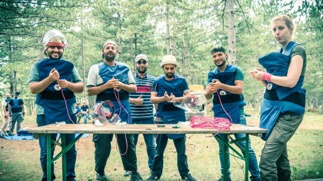
We welcomed 15 Libyan trainees, members of the police forensic department and EOD agencies and NGOs, for Levels 1 and 2 during July 2018. Demining activities have been particularly complicated to conduct in Libya due to renewal of the conflict in 2014. Several NGO’s operating in Libya had to alter the focus of their programs there on training local organizations and building the capacity of national mine action agencies. In addition, security concerns also hover above the heads of humanitarian work in Libya in which immediate and sudden personnel and equipment evacuation is very common; a fact that hinders all mine-action activities which are by their nature time-consuming.
Level 3 marked the enrollment of 3 trainees from Sudan, a country that has been suffering a 20year internal conflict, in addition to Libyan trainees from Level 2. The trainees are now IMAS EOD Level 3 qualified and some of them are returning back to their countries ready to clear areas of ERW, helping post-conflict communities recuperate from the unfortunate effects of war.

Drawing upon sources including national mine action centres, UN agencies, humanitarian mine action operators, and according to the Landmine Monitor (2017), since the Mine Ban Treaty, year 2017 marked the highest casualty numbers recorded with more incidents happening but not reported. 78% of casualties were civilians not military with a total of 42% children. The United Nation Mine Action Services annual report states that UNMAS programs were able to clear 8,800 kilometres of roads; the equivalent of the distance from Kabul to Capetown removing an estimate of 1881 landmines. Yet, it is estimated that there are around 110 million anti-personnel mines in land all around the world today.
Landmines and ERW do not only pose a short-term threat for civilians; they maim or kill individuals, hinder delivery of humanitarian aid, seclude areas by making them unsafe, and obstruct the reconstruction and development process. Mine action remains a central component that ensures the restoration of the lives of these people.